
Past Events – Speaker Series: February 22, 2026 Leslie Crenna – Prohibition in Moraga
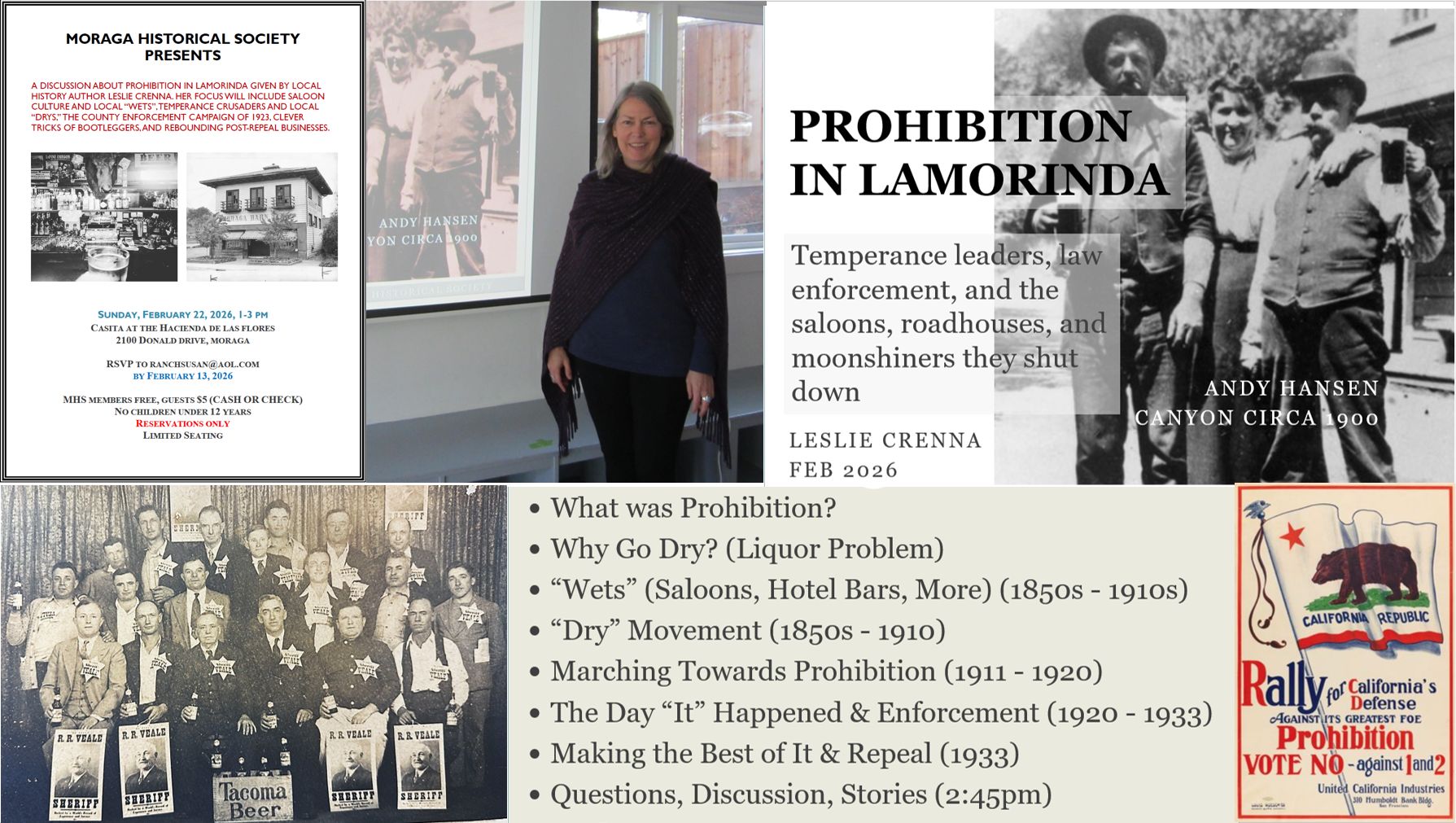
Guest speaker Leslie Crenna discussed Prohibition during early 1900s in Moraga
Vera Kochan Review and Photo
Another fascinating presentation for Moraga Historical Society members and guests was a discussion by researcher Leslie Crenna who uncovered the effects of the Prohibition Era on Moraga’s saloons (and there were several in the area). The Feb. 22 event at the Casita, located on the grounds of the Hacienda de las Flores, included astounding historical information along with a bevy of interesting slides. Crenna, who drove all the way from Woodland (near Sacramento), is in the process of writing a book about Prohibition in Contra Costa County.
Crenna’s presentation started with the Roaring 20s when women began to assert themselves (shorter dresses, public smoking and drinking). The world was changing with the invention of cars, the United States’ involvement in World War I, and the Stock Market collapse. “It was believed by many that saloons were ‘the cause’ of all the excess drinking problems, and so it was time to close them down, because moderation was not good enough.”
Moraga’s neighbor, Canyon, had saloons (“the wets”), that stayed open to “feed” the cravings for liquor, which were called “spoon foggles”. Before Prohibition, there were land feuds over saloon territory that often ended in murder. Hanson’s Hotel & Saloon (1890) and Bottomley’s Place (Redwood Inn) were establishments that also offered gambling and cock fighting. “Many saloons didn’t even have a liquor license,” stated Crenna. In 1913, when the trains came rolling through Moraga, their employees were supplied with liquor from the Moraga Valley General Store during depot stops.
The temperance movement was responsible for establishing “the drys” – locations where the drinking population could frequent that didn’t sell liquor. The Women’s Christian Temperance Union (WCTU) was formed by women who were tired of their husbands spending hard-earned wages and coming home drunk and abusive. Its members would wreak havoc at watering holes by throwing stones, singing temperance songs, and praying.
January 17, 1920, was the day the manufacturing and sale of alcohol became illegal throughout the United States, and Prohibition was established (the Volstead Act). However, before the law came into effect, people scrambled to buy liquor while they still could. The downside of Prohibition was that it fueled bootlegging, organized crime, and corruption until it was repealed in 1933.
Some institutions, such as Moraga’s Saint Mary’s College, found a loophole in the law by manufacturing sacramental wine. Eventually, the Town’s Moraga Bar added the letter “n” to its name, because local law prohibited the advertising of saloons. Hence the name “Moraga Barn”.
