
Resources
The Resources section of our web site provdes information about the physical and digital resources individuals can access in person at our History Center or online to research topics related to the history of the area covered by the Rancho Laguna de los Colorados land grant which includes the Town of Moraga as well as Canyon, parts of Orinda and Lafayette, and beyond. This section is for archived material in its digital and physical form; the Moraga History section is for expository or interpretative content.
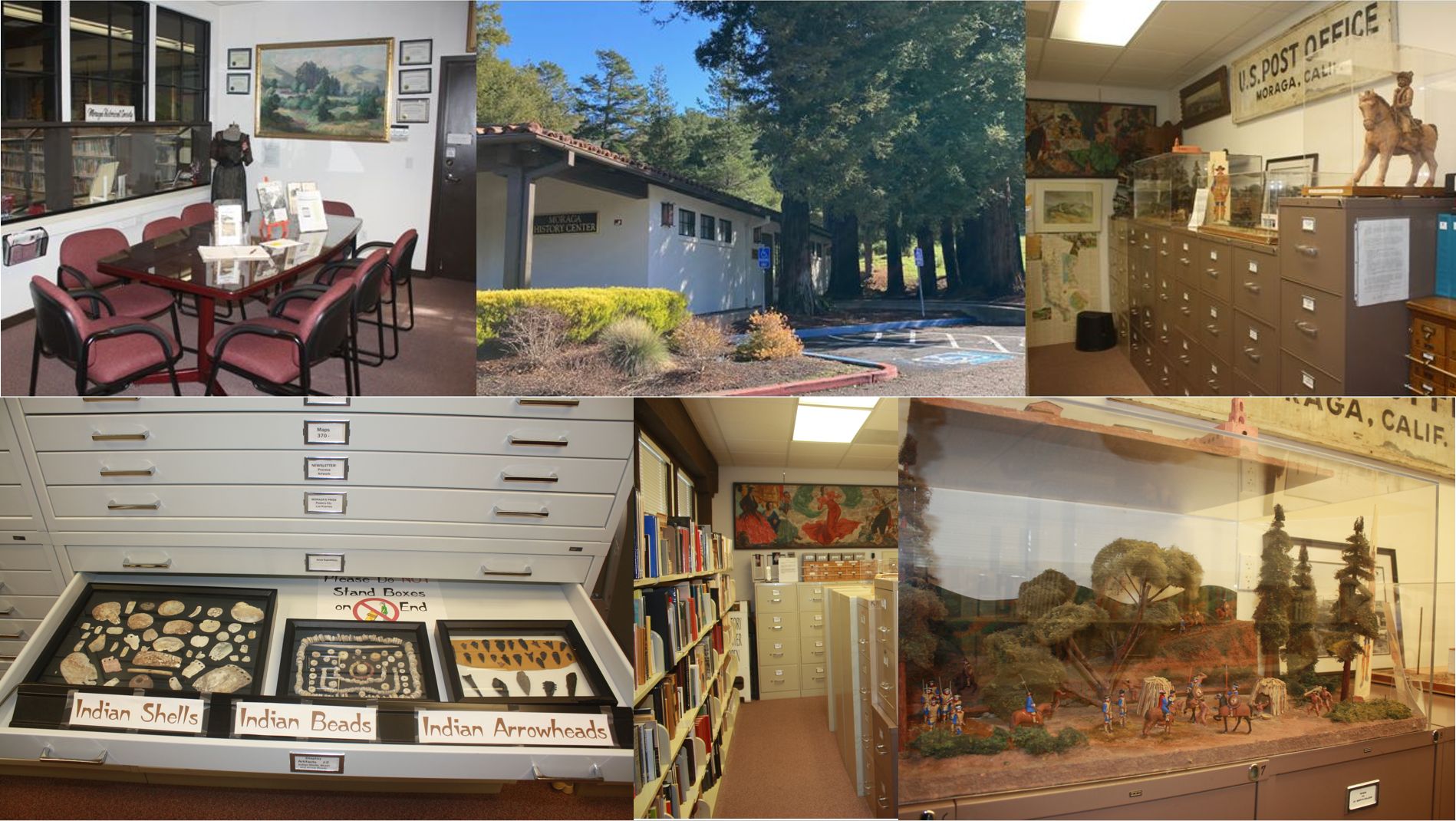
| History Center | The Moraga History Center is located on the west side of the Moraga Library at 1500 St. Mary’s Road, Moraga, CA. It houses all our physical archive collections including books, artifacts, photographs, maps, documents, audio and video media, as well as display models and dioramas. It is open to the public on Thursday from 1-3 pm or by appointment.The entrance is around the corner to the right of the main library entrance. | |
 |
||
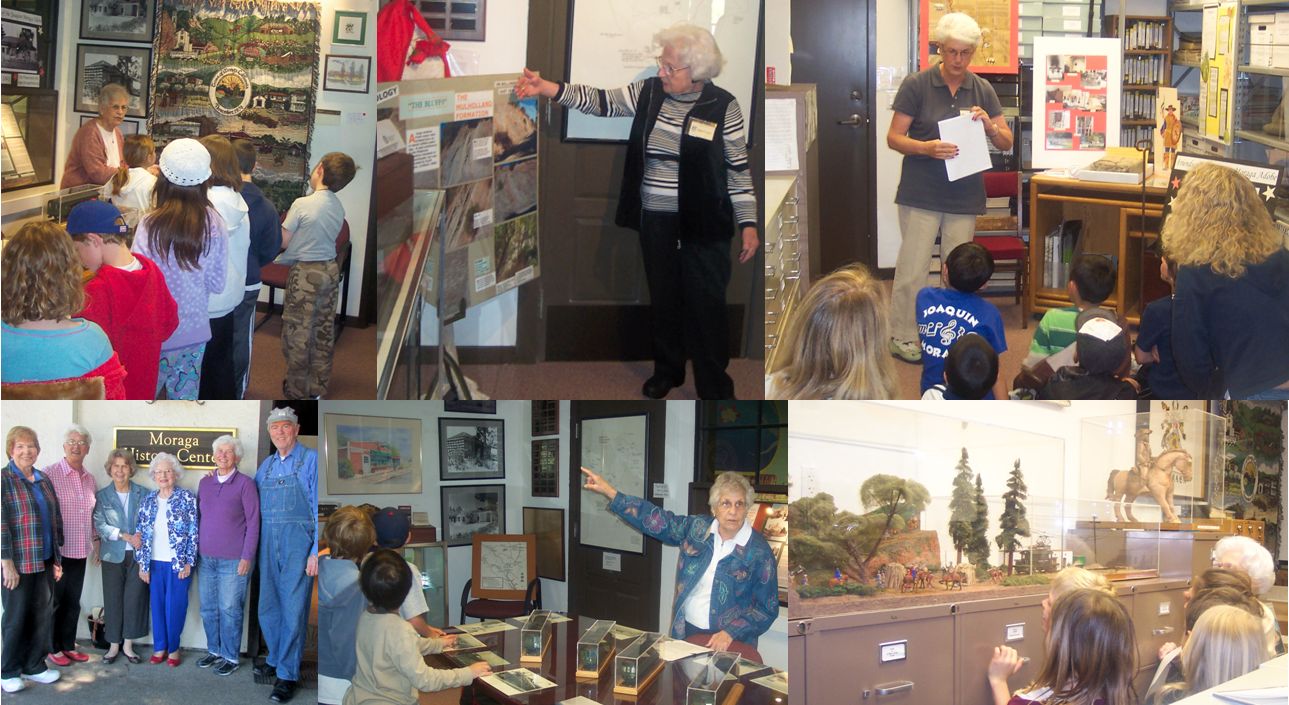
| Third Grade History Tour | Every April the Moraga School District third graders visit the History Center to complete their unit of study on the history of the town of Moraga. The Center’s three rooms contain displays especially prepared for their visit. Schools participate in one of three days whose sessions are held from 9:00 am until noon. Each group of about 15 students rotates through three rooms where they are given a 15 minute presentation by an MHS volunteer. One room discusses the origin of Moraga in terms of its geology, paleontology, and Native American culture and its intersection with the Spanish mission period. Another room deals with Moraga’s 20th century including its train history. A third room covers the ranching and farming history of Moraga. Each volunteer will do nine 15 minute presentations over a three period to 120-140 students. | |
 |
||
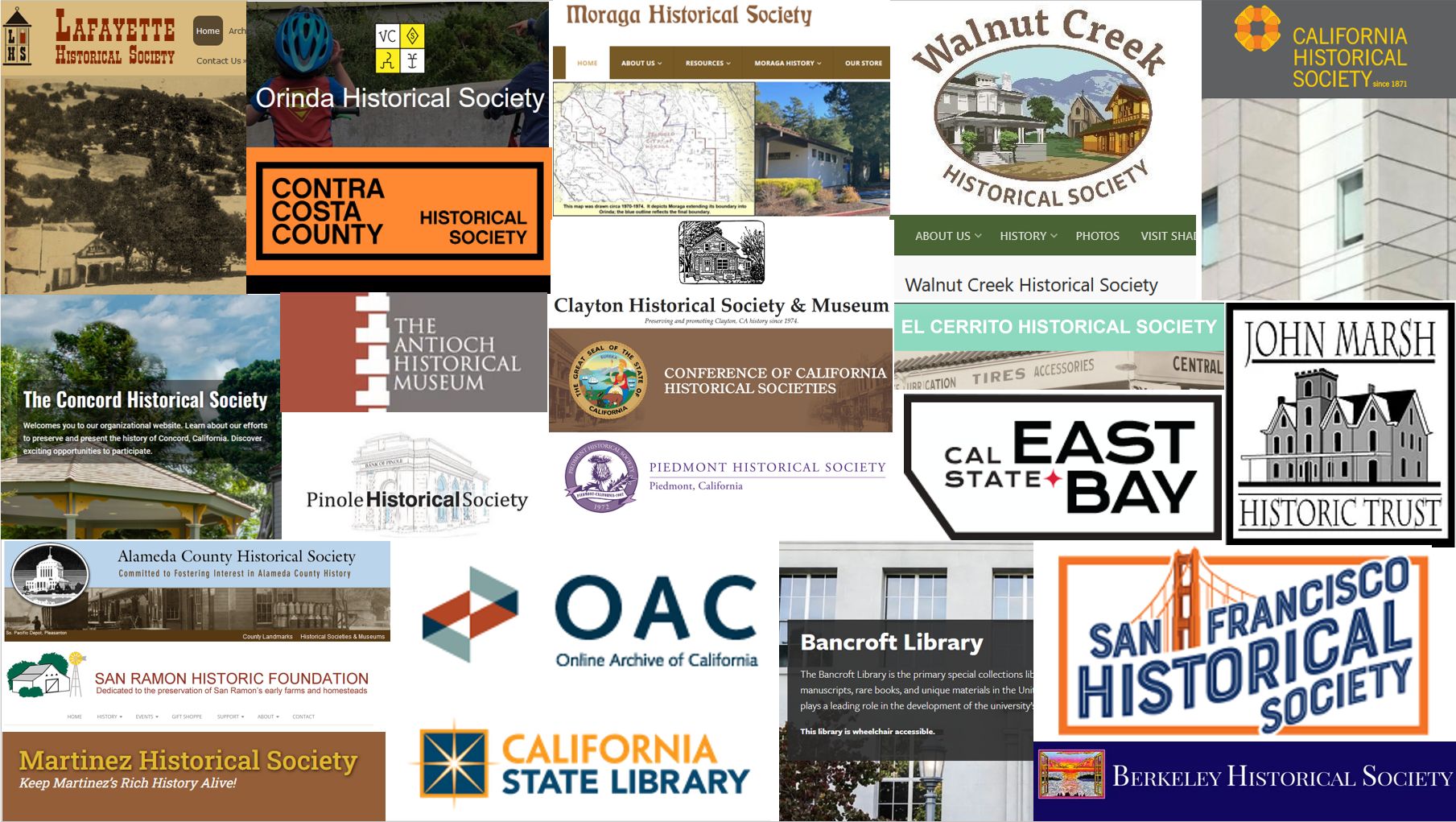
| Repositories | A growing link library of Bay Area historical societies, preservation trusts, museums and government run libraries and archives. | |
 |
||
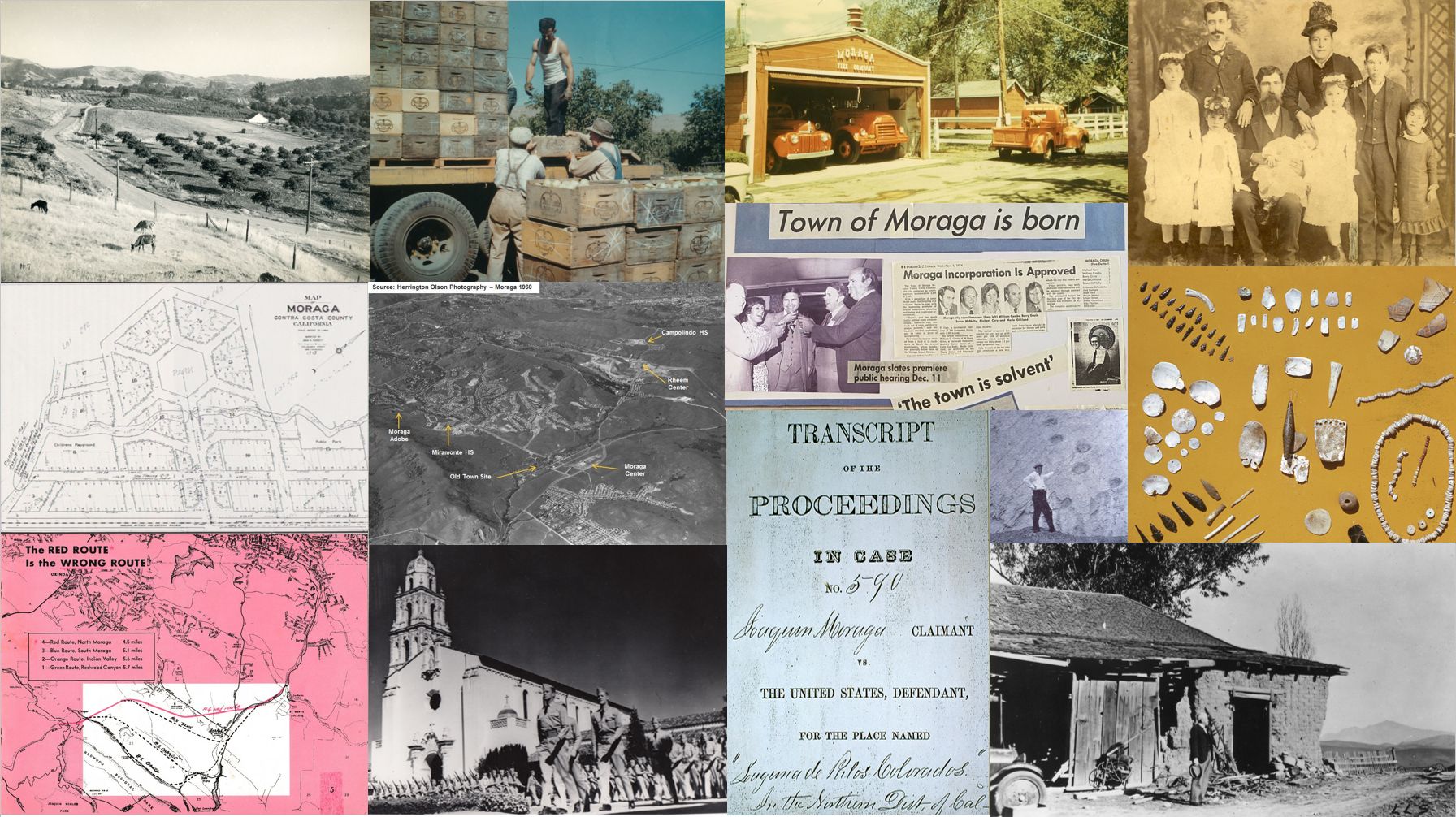
| Collection Archive General Subject Index | The Collection Archive General Subject Index provides a list of General Subjects, each of which links to a Catalog web page that lists all the archive items that have been digitized. Digitized documents, maps, photos, slides and audio/video items are presented in alphabetical order based on the original subject past archivists adopted and assigned to the item. Because there was no consistency in applying the same subject terms across all the archival collections a transitional strategy was devised whereby a group of very general subjects was developed which could be assigned to each digitized item. Over time a set of Specific Subjects will be developed to provide granularity and uniformity across all the collections. | |
 |
||
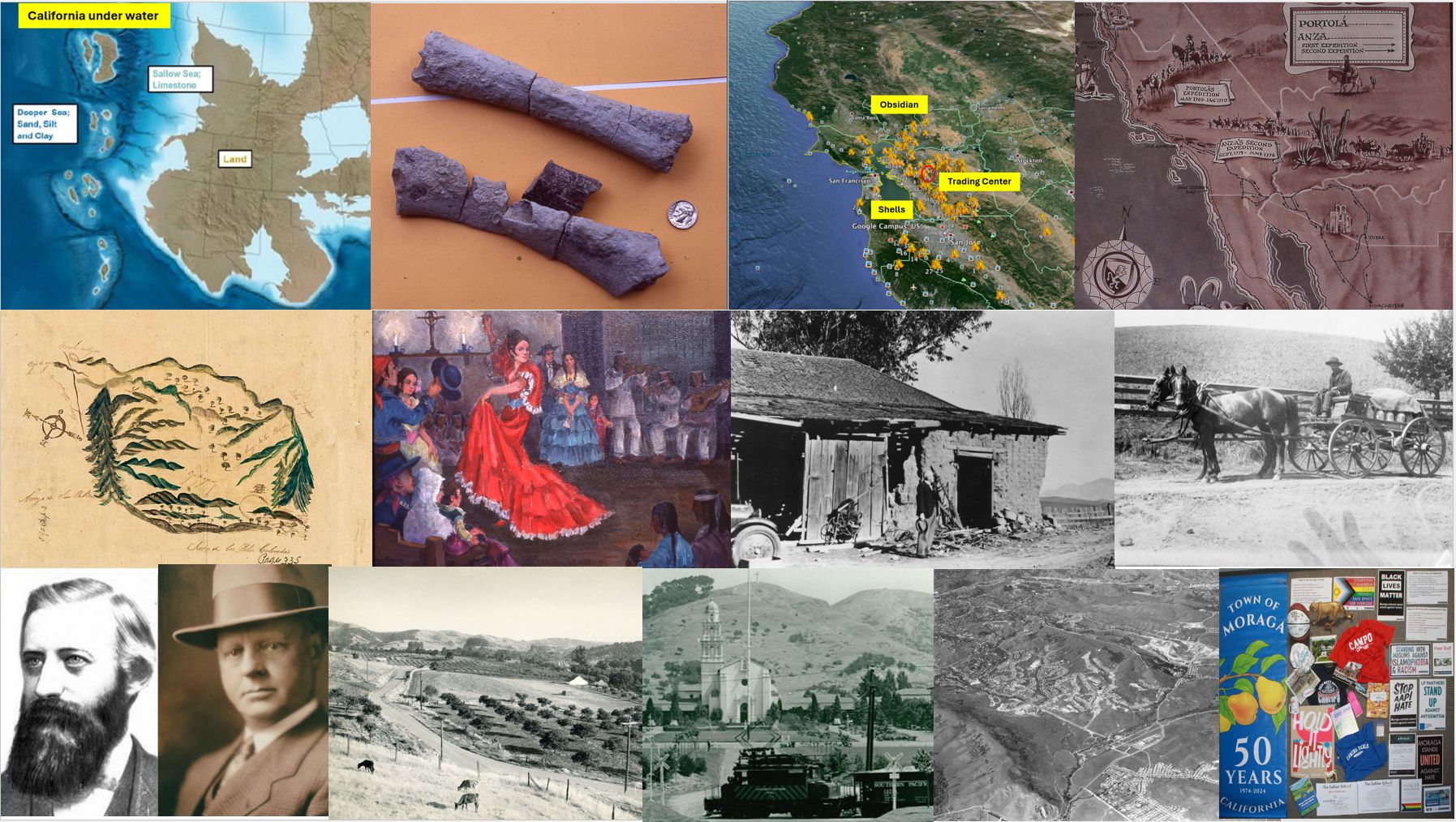
| Collection Archive Time Period Index | The Collection Archive Time Period Index provides a list of Time Periods, each of which links to a Catalog web page that lists all the archive items that have been digitized. Digitized documents, maps, photos, slides and audio/video items are presented in alphabetical order based on the original subject past archivists adopted and assigned to the item. Because there was no consistency in applying the same subject terms across all the archival collections a transitional strategy was devised whereby a group of very general subjects was developed which could be assigned to each digitized item. Over time a set of Specific Subjects will be developed to provide granularity and uniformity across all the collections. | |
 |
||
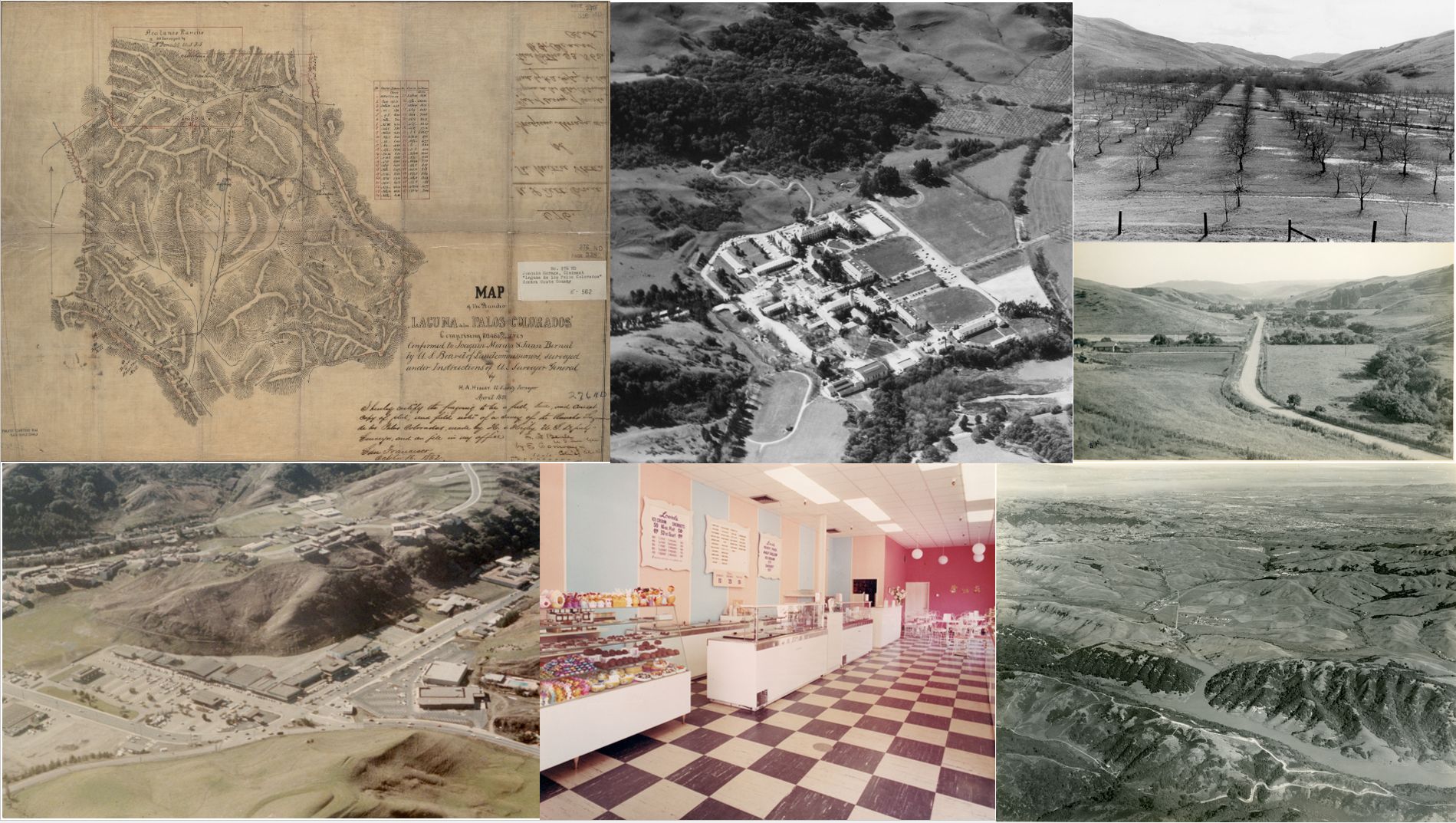
| Collection Archive Location Type Index | The Collection Archive Location Type Index presents the different location types and scales we can assign to items that have an identifiable geographical location. Items which have no identifable location such as photos of people are classified as “not applicable”. The notion of “scale” applies mainly to maps and aerial photos whereas “type” classifies digitized items as buildings, farms or ranches, parks, churches, utilities, lots and so on. The purpose is to create catalogs that allow users to search on the basis of location type and to provide a framework that will allow us to create GPS coordindate based interactive Google Earth based maps within the web site. | |
 |
||
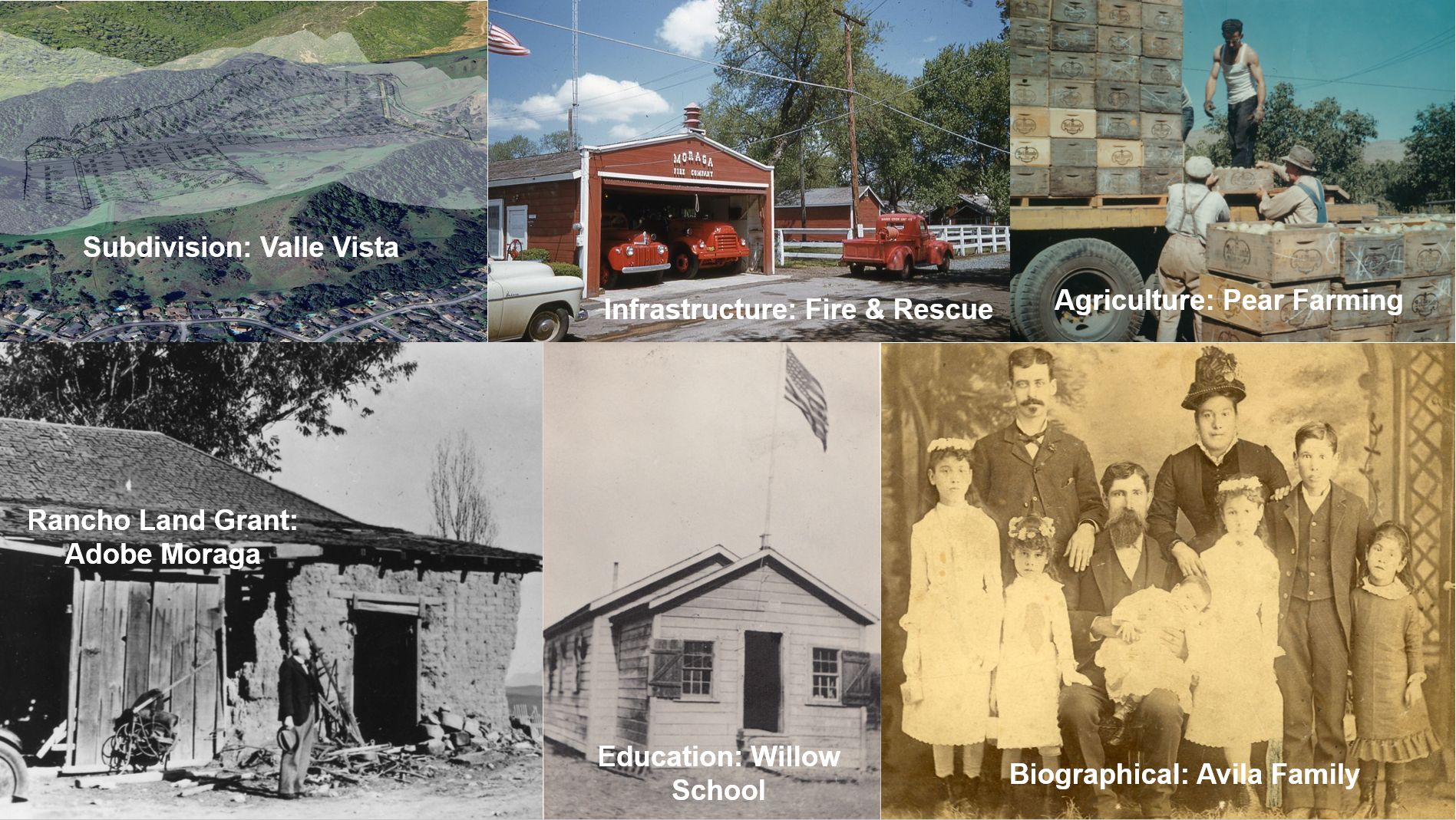
| Collection Archive Specific Subject Index | The Collection Archive Specific Subject Index is a work in progress necessitated by the fact that over the decades archivists have not always been consistent in assigning subject names to folders in the various physical collections. We have legacy spreadsheet lists for most of the collections whose subject names we have retained in our new database which keeps track of digitized items so that we can find the physical items in the folders or locations where they are stored. As we scan items we assign a general subject, time period and location type so that the scanned item can show up in these catalogs sorted by the legacy subject. This is the closest we can come to making our digitized items searchable. Over time we will develop specific subject names that unify the legacy subject names, For example, there are several different folder subjects for fire department related documents, slides and photos which are unified as the specific subject “Fire & Rescue”. The Collection Archive Specific Subject Index will list these unified subject names and provide a link to a calatog featuring only digitized items tagged with that specific subject. | |
 |
||
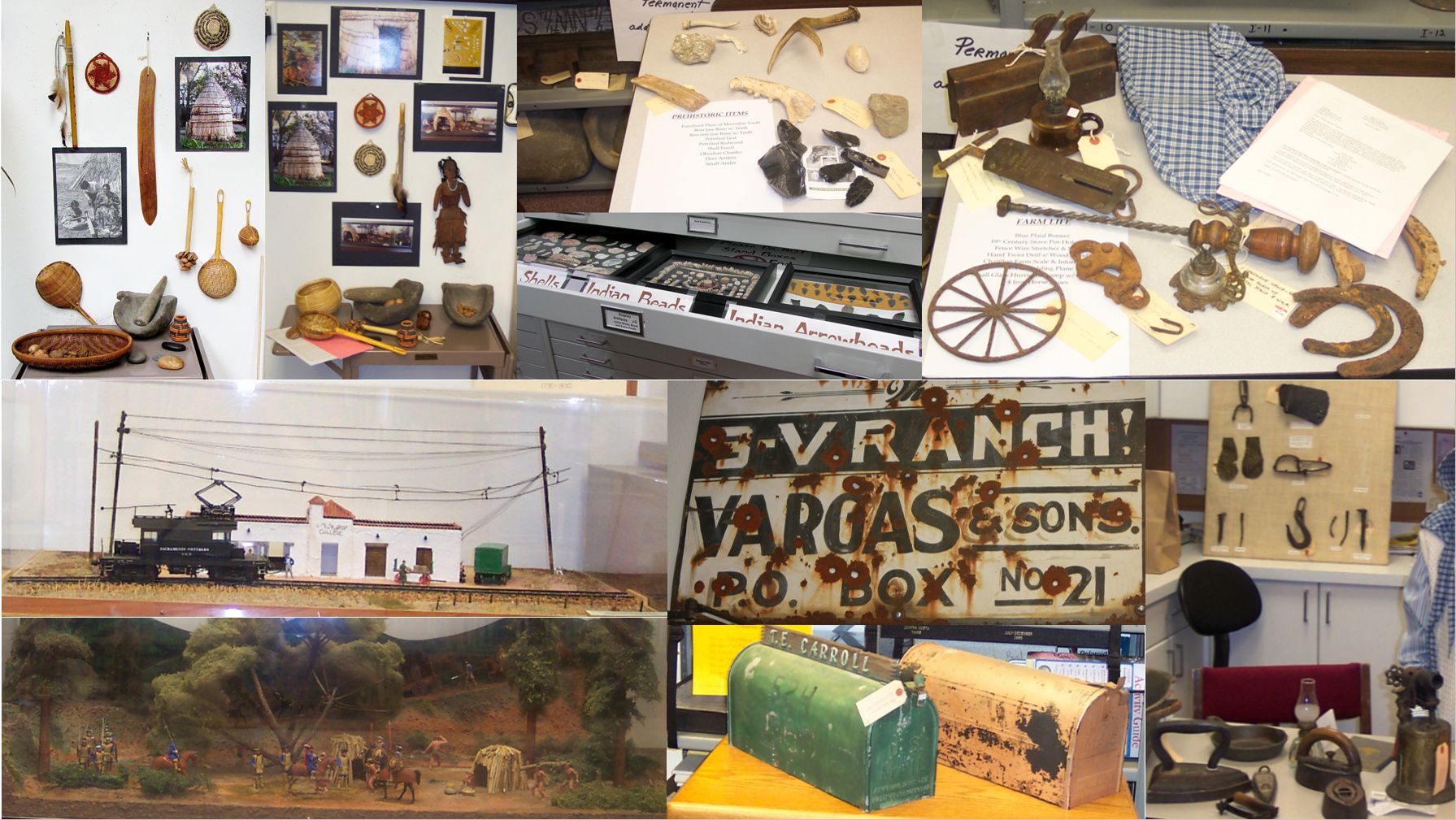
| Artifact Collection (coming) | The History Center houses a collection of artifacts, models, dioramas, paintings and posters donated or created over the decades. Some are on display while others are boxed and stored. The goal is to create an inventory of these physical objects, photograph them, and provide an online catalog. The artifact collection gets the most attention during the annual Third Grade History Tour. | |
 |
||
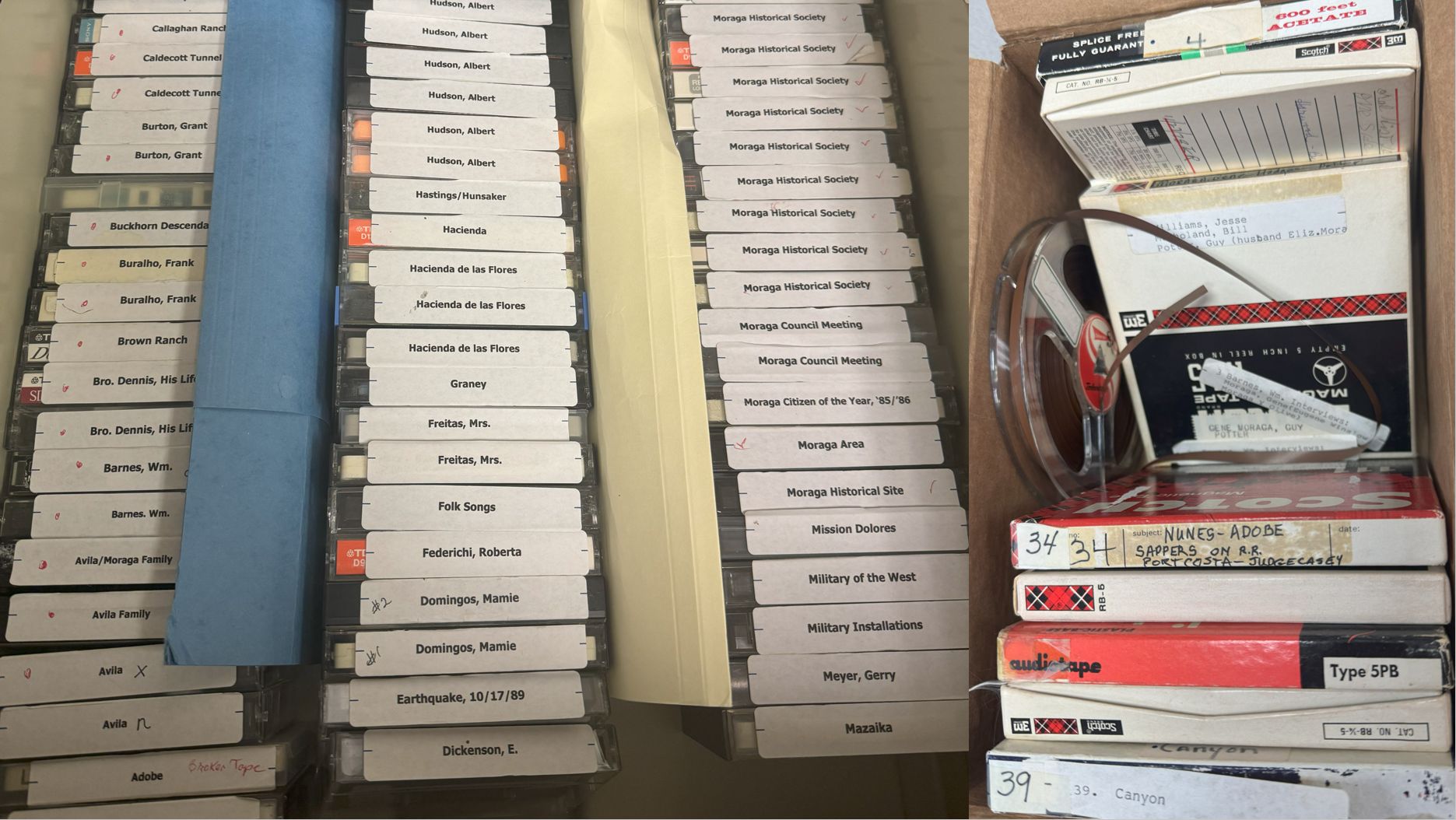
| Audio Collection (coming) | The History Center has a collection of audio recordings mainly of past speaker events and oral histories in the form of cassettes, some of which were converted into digital auadacity files by student volunteers in 2015. An effort is now underway to convert them into a format that allows us to post them to our YouTube Challenge. This index page lists the physical audio media we have in our archives. Converting the audio collection into online digital files will be undertaken after we have finished the Video Collection. | |
 |
||
| Book Collection by Subject Book Collection by Author |
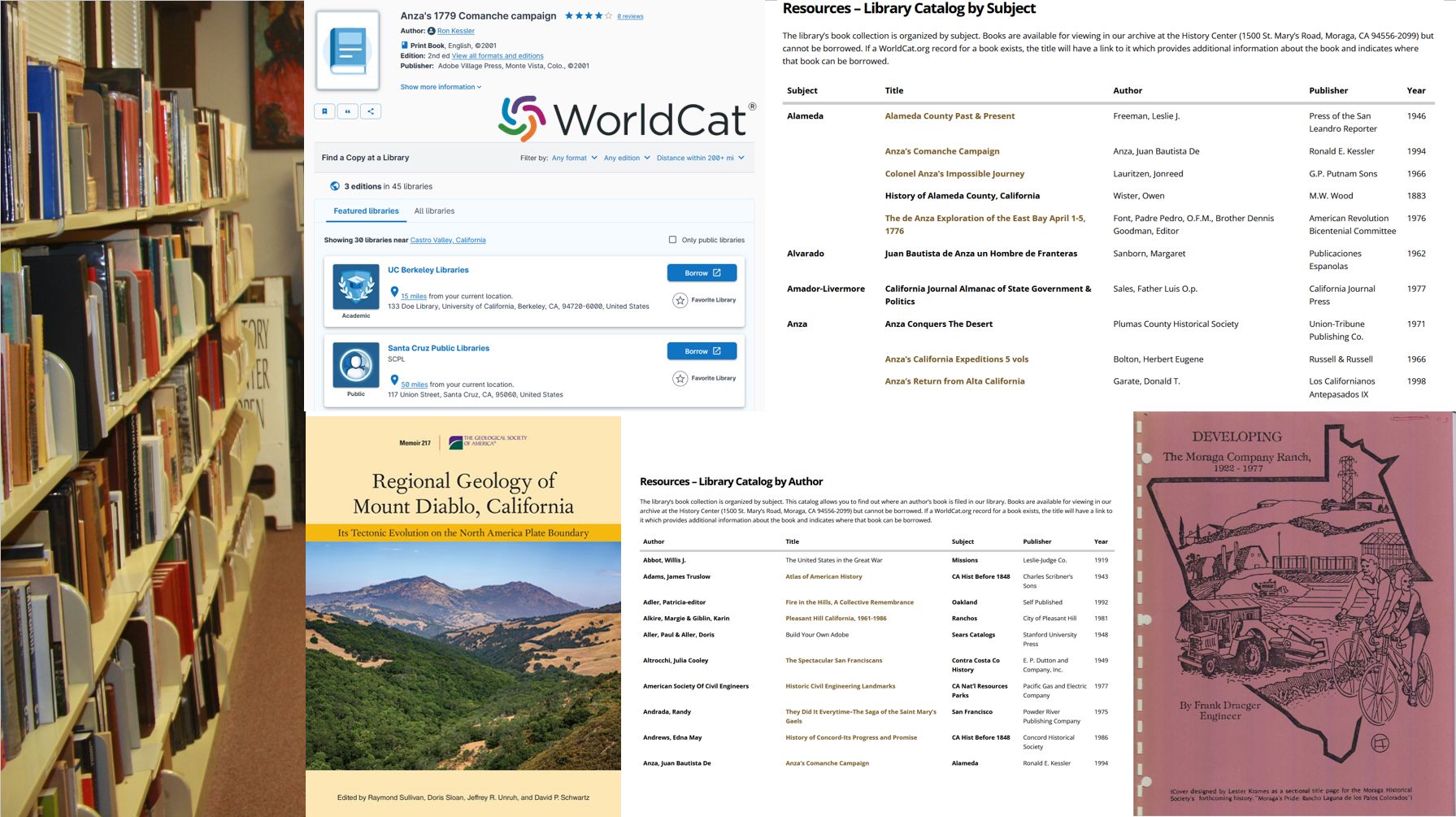
The History Center has a library of 450 books and manuscripts related to the history of California, the Rancho land grant, and the surrounding communities. These two catalogs sort the book collection by author and subject. We do not lend out our books, and, given the History Center is only open one day each week for two hours, this makes it difficult to read any of these books. However, we have tried to track down the WorldCat reference for each book and when successful have provided a link in the catalog. The WorldCat reference is helpful because it provides additional information about the book, and if it can recognize your location it will list all the public and academic libraries in your area that have the book. When researching a topic you can first check out our library catalog and visit the History Center to take a look at the book to see if it is worthwhile to borrow it from a library that does lend it out. Books for which we have a WorldCat reference have a bronze colored title indicating a link. Our Book Collection includes manuscripts and memoirs which are not listed in WorldCat or were never formally published, such as Frank Draeger’s memoir about the development of the Moraga Valley. Our goal is to identify these books and scan them if possible so that we can provide a pdf version online. | |
 |
||
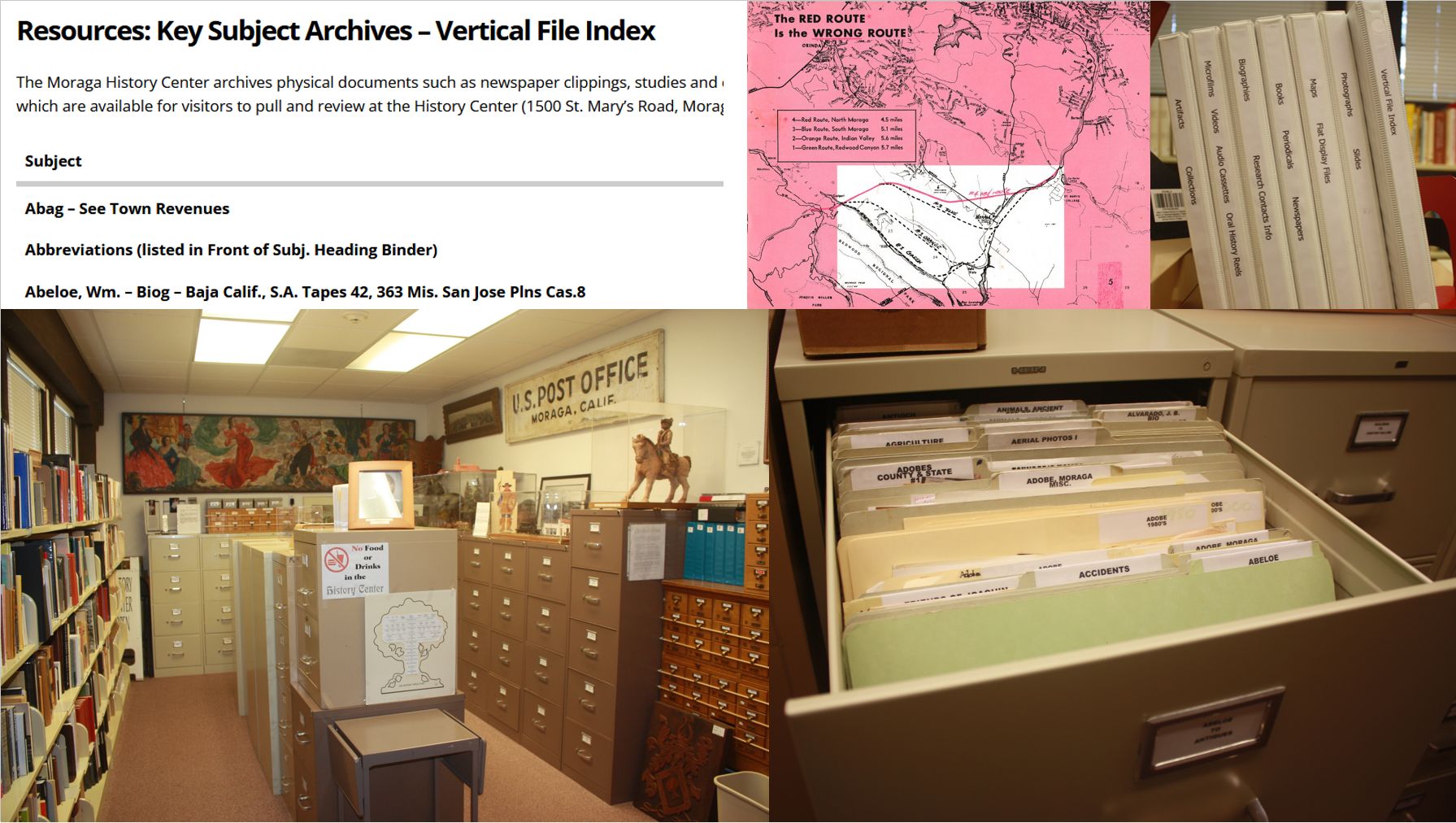
| Document Collection | The History Center archives physical documents such as newspaper clippings, studies, pamphelts and other material organized by subject in what we call the Vertical Files which are available for visitors to pull and review at the History Center during our open hours or by appointment. Documents are stored in subject named folders stored alphabetically in filing cabinets. The legacy index includes references to documents stored elsewhere in the history center such as the map drawer for oversize documents, so it is somewhat confusing. Original photographs are stored in separate subject named folders in filing cabinets off limits to visitors. The documents folder for a subject will have a set of photocopies of the photo prints in the corresponding photo folder. The idea is that if a researchers wishes to view the original print one asks the MHS staff member to pull that folder. Our current priority is to scan all the photo folder prints and make them available online. | |
 |
||
| Key People Collection | The Key People Archives Index is a temporary list made available because past archivists had created a list of “biographical” subject folders in our Documents Collection featuring families or individuals involved with the Moraga Valley’s history and written brief descriptions about these people and what the folders contain, which sometimes is not much. Whatever we are scanning from these “biographical” folders we are tagging with the “Biographical” General Subject so that these items show up in one catalog. When all the biographical document and photo folders have been scanned these “key people” will become Specific Subjects with their own dedicated catalog web page. | |
 |
||
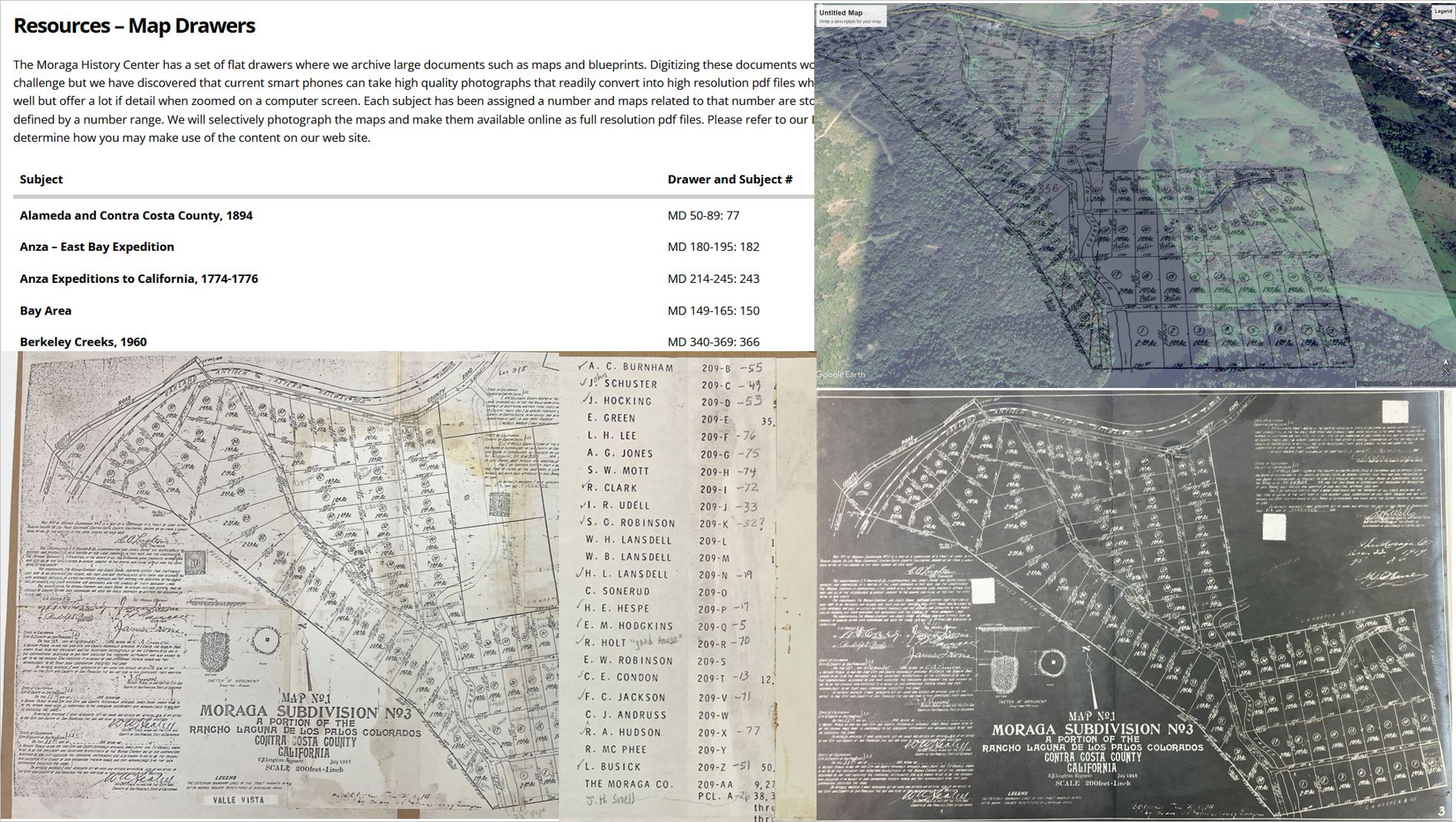
| Map Collection | The History Center several map drawer filing cabinets where we store “oversize” documents such as maps, blueprints and posters. They are not organized according to alphabetical subject so this index is key to figuring out in which drawer the document is located. The oversize documents cannot be scanned but we have discovered that the lighting in the map drawer room is ideal to take photographs with a smartphone camera. These in turn can be converted into pdf files with an amazing degree of resolution as we discovered when we photographed the maps in the Valle Vista Subdivision folder. Some maps have been annotated with additional information. We have also figured out how to lay these maps onto Google Earth and view the lots in spectacular 3D. Our plan is to “scan” these maps on a selective basis and make them available online. | |
 |
||
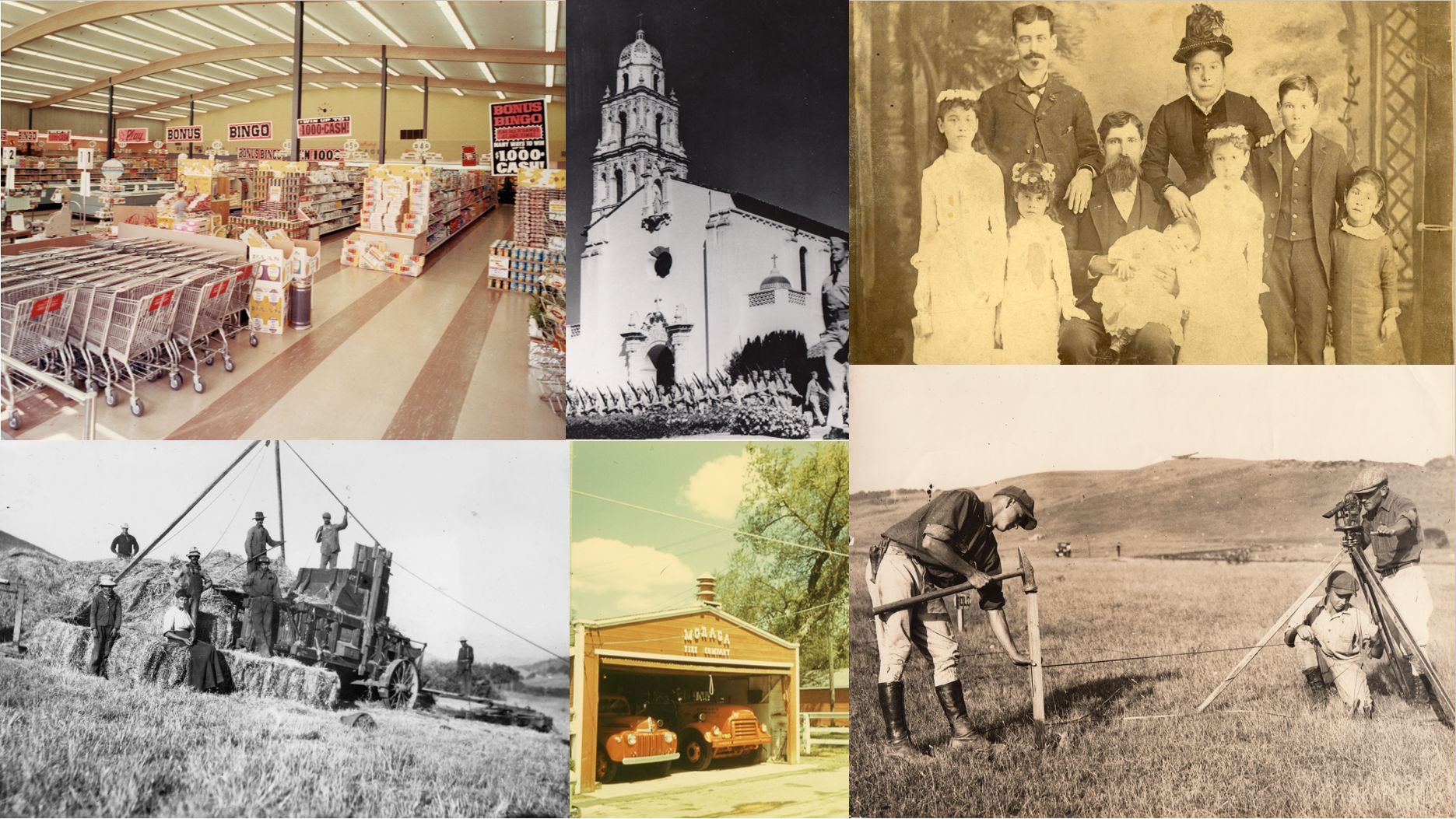
| Photo Collection | Over the decades we have acquired numerous photo prints through donations, the most recent example being a set of 58 large size prints by the Donald Rheem family. The prints are located in subject based folders stored in a separate set of filing cabinets to which only MHS staff has access. We are scanning and saving these photos tif files and converting them to jpg files that are available online on a fair use basis. While the online jps have good resolution that reveals amazing detail when zoomed, anybody wishing to make printed use of an image can contact MHS to obtain the tif file version and sign a release if commercial use is intended. Where the photographer is identified we include the name in the catalog, but many prints have an unknown origin. The date is often missing or incomplete. We have developed a system for inputting the date and tagging accuracy in terms of day, month, year and decade. This information is usually on the back of the photo. We enter as much of this extra information in the scanned item record, but if there is a lot of detail we will also scan the back of the print. | |
 |
||
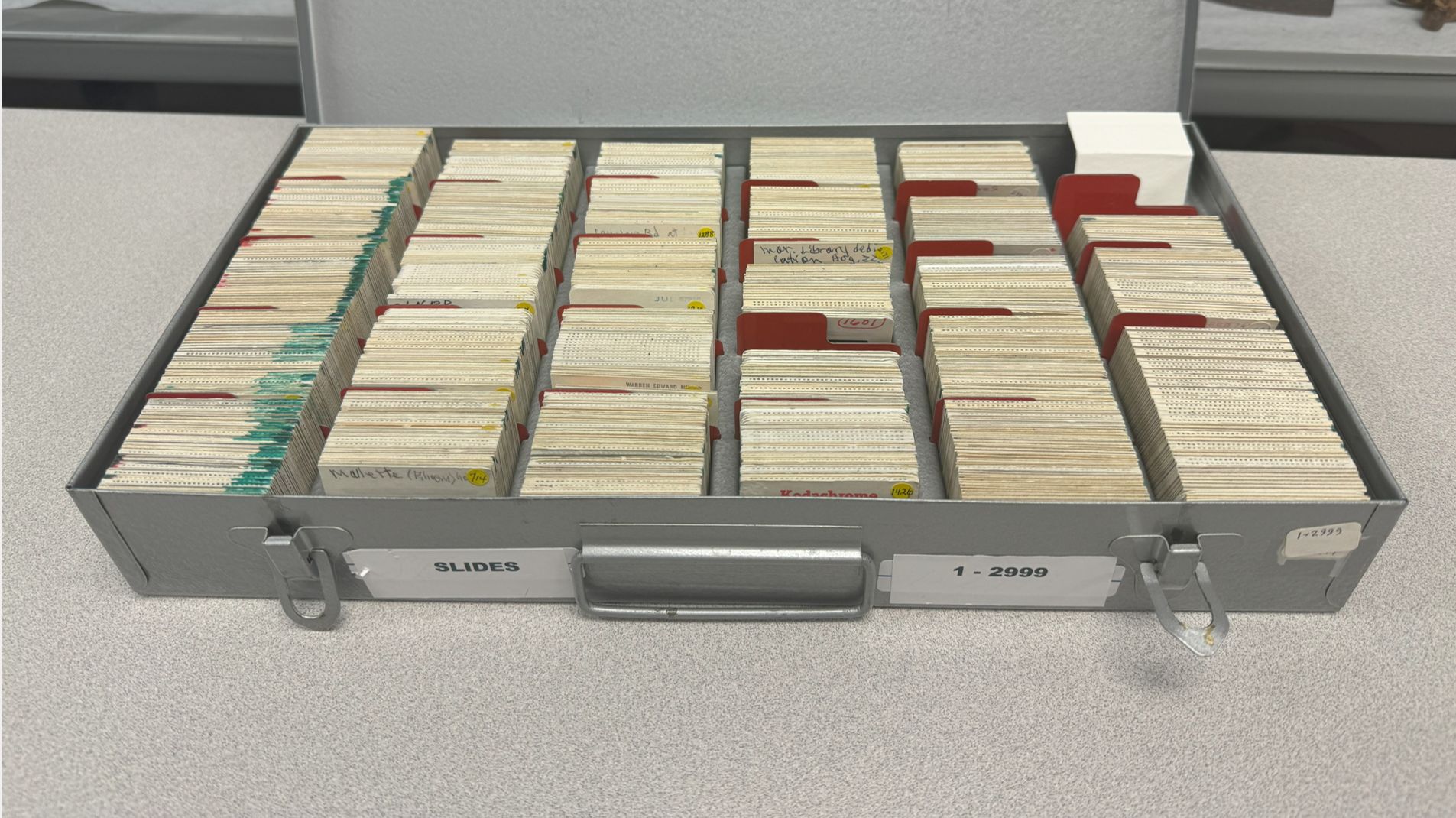
| Slide Collection | During the 1970s and 1980s unknown MHS members took photographs with slide film that resulted in a collection of 840 slides stored in an inaccessible metal box. We had no idea what they were about so we scanned all of them. We were lucky to find a spreadsheet index with information provided by past archivists which consists of a “subject” and a “name”. Thankfully slides have a date printed on them which we have recorded. Many of the slides are photographs of photographs or museum exhibits taken during Romerias. The slides are all in color and very revealing about what the Moraga Valley looked like during this period just before and after incorporation. We have assigned a time period to each slide and created catalogs based on the time period. This index provides a list of the time periods with links to the catalogs. We have done our best to assign general subjects and location types to the slides so that we can blend them with scanned items from our document, map and photo collections. | |
 |
||
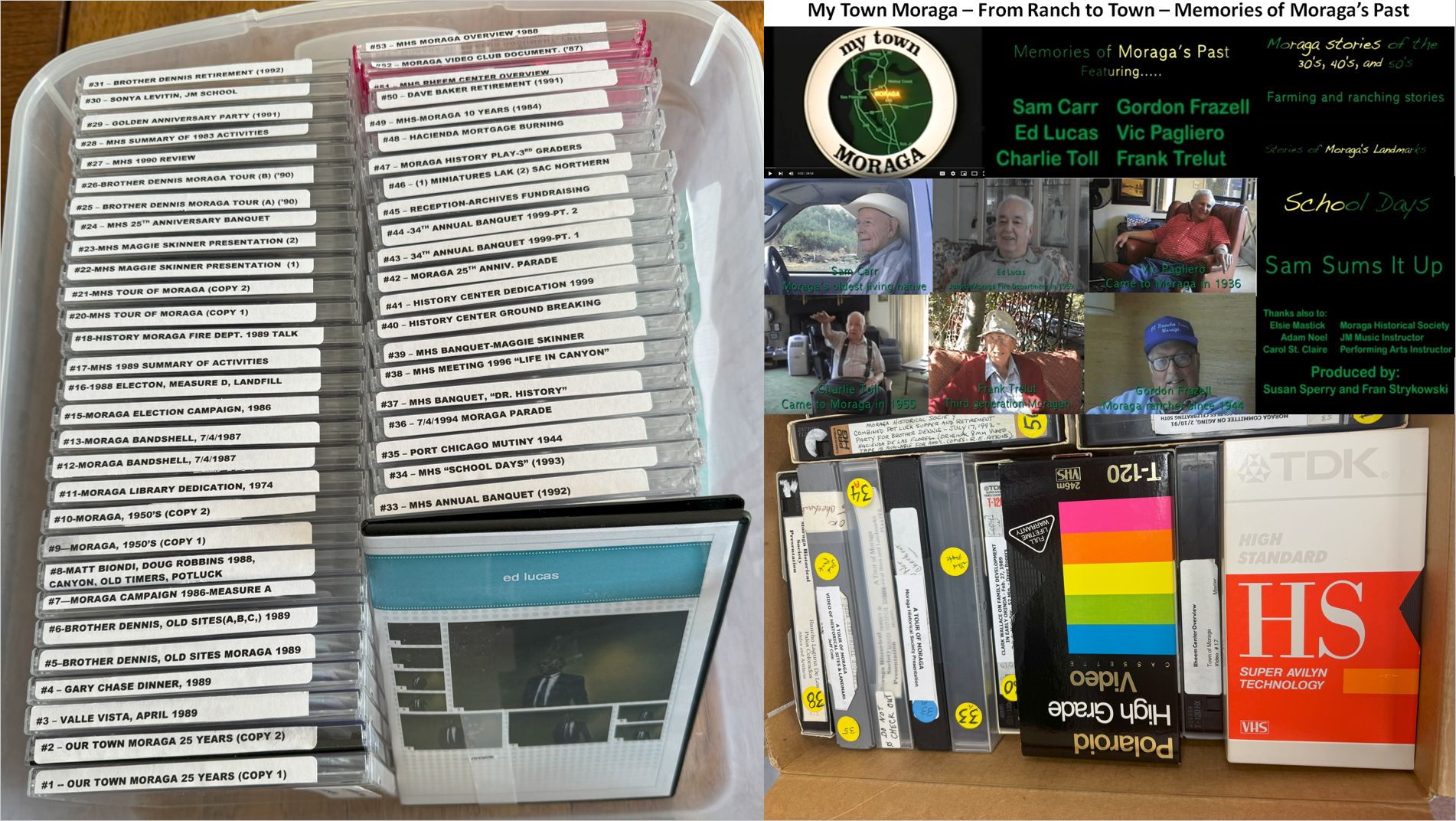
| Video Collection (coming) | The History Center has a collection of video recordings mainly of past speaker events and oral histories in the form of tape reels and video cassettes, many of which have been converted to DVDs. We have begun the process of converting these 52 DVDs into MP4 files which we are posting to our You Tube channel. Within are web site are presenting them in the Moraga History section called Voices of the Past which also provides a link to a web page for a video if we have created one such as we did for the 1989 Fire Department History Talk by former fire chief Ed Lucas. These involve cleaning up a transcript extracted from YouTube, breaking the talk up into “chapters”, and adding relevant images form our digitized archives. Getting the DVD video collection converted and posted on YouTube with an accompanying MHS web page is a priority. | |
 |
||
