Volunteer Organizations that shaped Moraga’s Destiny
By Susan Sperry Excerpt from Newsletter 2026 Q1

Moraga Community Association, Inc. (MCA)
Prior to James Irvine’s 1914 purchase of the Rancho Laguna de Los Palos Colorados, Moraga community news was shared at small informal gatherings. Dairy farmers and ranchers socialized at each other’s homes and discussed local happenings, or later at the Moraga Barn. Upon Irvine’s death, his Moraga Company Board began selling off parcels of the rancho.
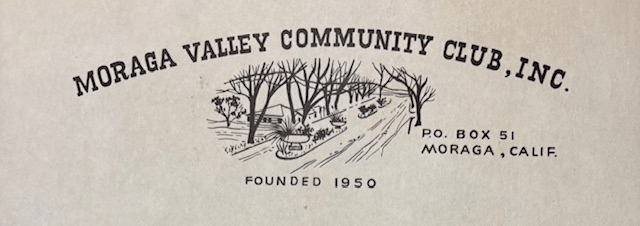
As the community grew, a pattern of resident participation in local government emerged. An enthusiastic core of volunteers developed a degree of commitment rare in other communities. Volunteerism began as early as 1950 with the formation of the Moraga Valley Community Club, Inc. (the Club).The club’s purpose was to represent Moraga residents in Martinez, where control of future development resided, and to fight what became known as the “Martinez Mentality”—the continued overriding of local citizen preferences for growth control.
This group became the Moraga Community Association, Inc. (MCA), “the Voice of Moraga”. Annual dues were $3 and committees included membership, civic affairs, traffic/roads, public safety, and liaison to parks. The Moraga valley was then divided into nine (9) districts with two directors, each serving the residents of their respective districts. As per the by-laws, MCA was tasked to “democratically investigate, promote and accomplish such needs and projects as will lead to the social, moral and civic improvement of the community.” MCA managed local matters representing Moraga citizen’s wishes including fire protection, sign control, residential development, bus transportation, freeways/highway construction, and General Master Plan issues. MCA was dissolved on March 3, 1976.
Citizens to Incorporate Moraga (CIM)
As early as May 1966, the club formed the Moraga Community Association Committee for the study of incorporation. This committee was to conduct a study to provide the residents of Moraga with detailed basic information regarding municipal incorporation outlining apparent advantages and disadvantages.
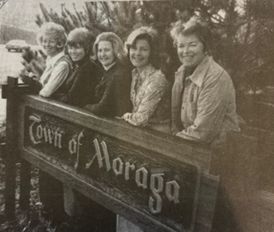
Then in October 1973, Citizens to Incorporate Moraga (CIM) was formed to further study the matter. Finding that incorporation was indeed a viable idea, letters were sent to all Moraga households on January 12, 1974 announcing that the committee had filed an application for incorporation with the Local Agency Formation Commission (LAFCO). On January 18, 1974 a town meeting was held and on February 6, 1974 the CIM study was submitted to LAFCO requesting an election. On March 6, 1974 LAFCO approved the election. On April 1, 1974, CIM filed a “Notice of Intention to Circulate a Petition for Incorporation of the Town of Moraga”. The County Board of Supervisors approved the boundaries as set by LAFCO and voted on July 2, 1974 to put the incorporation question on the November 5, 1974 ballot. CIM became formally organized and 75 coffee conversations were held around the community. Thirteen candidates announced their intention to run for Town Council. Keep Moraga Unincorporated (KMU) formed quickly, joining the “No on Measure M” camp. However on November 5, 1974, Moraga became the 15th city in Contra Costa County.
Moraga Service League (the League)
While MCA and CIM focused on development and incorporation, the Moraga Service League (the League) was formed in May 1969 to provide a service and fundraising organization to function exclusively for the general welfare of Moraga. The Service League was open to all residents willing to dedicate their time, talent, and energy to benefit their community. League events raised funds for Moraga’s first paramedic ambulance, the Town Parcourse, the Band Shell, and Frisbee golf course. Other projects included blood drives, bridge and tennis marathons, LMYA, Moraga Beautification, Block parents and the 2-day Fiesta de Moraga. Over its 16-year life, the League raised $150,000. But by May 1987, the active membership dwindled as did enthusiasm and a cause. Women were going back to work, and the 60+ members just became inactive. Services which the League had funded were now financed by tax dollars. With much sadness, the Service League disbanded in 1987, and its members sought other community service opportunities.