
The Journey of the Moraga Historical Society
By Susan Sperry Excerpt from Newsletter 2025 Q4
Sonia Levitin Remembers the early Moraga Historical Society*
The year was 1965! The Vietnam War is raging; the Voting Rights Act is signed into law by Lyndon B. Johnson; the Sound of Music is released, and A Charlie Brown Christmas is the first animated television special. Jerry Brown is Governor of California, and the population of Moraga is 1,500! Moraga is booming with residential real estate development. The controversy about the Cal Trans plan to push the Shepherd Canyon freeway through Moraga Valley is growing. The community is outraged about new houses crawling up and down the hilly open spaces and discussing incorporation to take control of Moraga’s destiny.
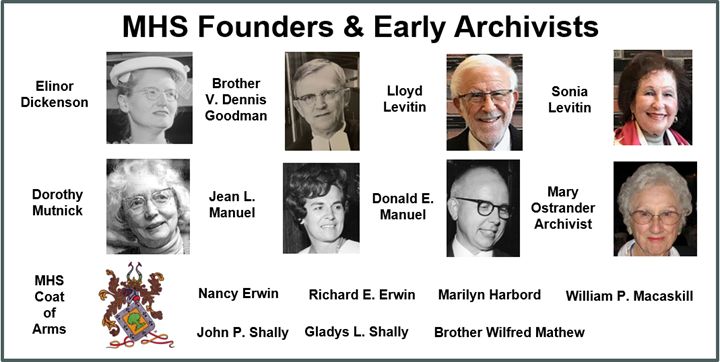
In 1965 Sonia and Lloyd Levitin had just moved to Moraga. Sonia is quoted as saying, “When we first came to Moraga I wondered about the unique Spanish style building on the hill. I wanted to get a closer view but was reluctant to invade what was private property. It was Postmaster Elinor Dickinson who told me it was the Moraga Adobe, granted to the Moraga family long ago. It was the first time I heard of a land grant, and I began to read about these. When I asked Elinor where I could learn more from the local historical society, she just laughed and said I would have to start one.”
Sonia continues, “I was busy with two young children and a growing career as a writer. But I’ve always been interested in new beginnings, especially, close to home. So, I elicited the help of my husband, Lloyd, and several friends. I don’t have all the names, but I do recall the Cowans, Don and Jean Manual (owners of the Adobe who I had contacted and visited with), Joyce and Jack King, Brother Dennis and Brother Matthew both of St. Mary’s College”.
The Moraga Historical Society was formed on October 12, 1965, and the first meeting was held November 30, 1965. It was an open meeting with a presentation by Eugene Moraga, the last person born at the Adobe, an overview of the Rancho by cartographer George Collier, and a panel discussion followed by Q&A. The Moraga community’s response was tremendous. “We planned the initial meeting, with advertisements in the local newspaper and word-of-mouth, expecting about 20 to 30 people who might be interested. To our great astonishment, over 300 people crowded into the room.” The Fire Marshall had to limit how many people could enter the room and therefore many waited outside. Luckily, Brother Dennis Goodman, the librarian at St Mary’s College, had long had an interest in Moraga’s history and had been accumulating historical documents. Sonia was not starting from scratch. Don Manuel became the first president and Board members were Elinor Dickenson, Nancy and Richard Erwin, Brother Dennis Goodman, Marilyn Harbord, Sonia and Lloyd Levitin, William Macaskill, Jean and Don Manuel, Brother Wilfred Mathew, Dorthy Mutnick and Gladys and John Shalley.
The initial archives were in a room at the old SMC library which Brother Dennis and Brother Matthew arranged to make available. Brother Dennis, Maggie Skinner, and Mary Ostrander were pivotal in collecting and archiving the deluge of historic documents that arrived.
Sonia, who now lives in Southern California, remembers, “Brother Dennis, with his love of local history, was the leader when it came to planning events like an annual banquet with many Mexican and early California foods, which some of the members prepared. We had 350 attendees at the first banquet.” The Contra Costa County Historical Society also participated in this first event which displayed artifacts from the Moraga family, with red roses and English Laurel branches for decorations. The reservation fee for the first banquet was $5!”
“Another annual event was the “Romeria” where we traveled to a surrounding town, especially ghost towns, to learn of other historical sites. These trips were often family events with activities suitable for children. We met frequently at the Adobe. Jean Manual graciously took groups of school children through the house and gave them a living-history lesson. My friend, Bernice Schlach, and I wrote a brief booklet about the Adobe and Moraga history, and I had an article published, LIVING IN A LANDMARK, in a Sunday newspaper supplement, about the fascination, and the restrictions that the owners experienced. As the Adobe is a historical, registered landmark, the owners cannot change the style or architecture; their home, in a sense, belongs to the community.”
“Monthly meetings held at the Adobe, St. Mary’s, the firehouse or circling around local schools, had various speakers, many who were old-timers, some historians, all with knowledge of early Moraga residents and local history. Dues were $25 yearly, with separate fees for the banquet, of course, and buses for Society trips.”
Reading the early monthly newsletters which began in 1966 demonstrates how vital, enthusiastic, and lively MHS was from its inception. The mission statement: “the discovery, preservation and dissemination of information about the history, development and growth of Moraga’s Rancho Laguna de los Palos Colorados and the Town of Moraga” was created, by-laws were instituted, officers and committee members were chosen and MHS became a vibrant volunteer organization. and in 1999 fund raising culminated in the construction of the History Center on the south side of the Moraga Library.
*Sonia Levitin is a writer, artist and world lecturer who was born in Germany, just before World War II. Her books have led to many speaking engagements speaking about slavery and genocide. She has given keynote speeches about the Holocaust, always emphasizing that history must be a tool for inspiring change, for acting. In 1965 she founded the Moraga Historical Society, in the ‘70’s the Peninsula Enrichment Program, and for several years led a program of Rape Awareness and Prevention. For over 20 years she has been involved in the Los Angeles Simon Wiesenthal Center/Museum of Tolerance. She lives in the LA area with her husband.
Early Archives and the Creation of the History Center
Brother Dennis Goodman, St. Mary’s librarian, was fascinated with the history of Moraga, and for years he had been collecting historical data from his own intense interest in the area. This research information plus artifacts collected in the surrounding area were stored at St. Mary’s College in the old library. (Still remaining in the current History Center is the file cabinet containing hundreds of index cards compiled by Brother Dennis with historical facts he collected.) Brother Dennis, Brother Matthew, Maggie Skinner, and Mary Ostrander were pivotal in collecting and archiving the deluge of historic documents and artifacts in the early years. Once the news spread about the creation of an historical society, residents began deluging the society with artifacts discovered during the hay days of construction occurring in Moraga. But over time, the SMC space became cramped, with limited access, and there was no room for volunteer archivists to get anything done.
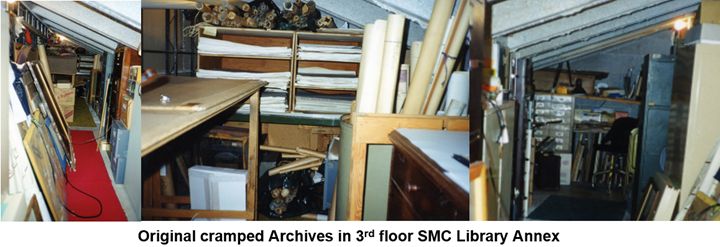
In 1996 MHS board member Jim Coy proposed that a permanent History Center be built as a west wing annex to the Moraga Library. This idea gained traction with the town council and Margaret DePriester championed the formation of the History Center Development Committee. With an overwhelming public response to funding this construction, $150,000 was raised to build a three-room 800 sq. ft. annex. MHS board member Dave Trotter was able to secure a 40-year zero cost tenancy lease for the Moraga Historical Society. The dedication took place on July 4, 1999. Brother Dennis, Mary Ostrander, Maggie Skinner, and countless volunteers embraced the challenge of moving the archives into the new History Center which has become a place for community members to visit and/or do research. For years, the Center was under the watchful guidance of Elsie Mastick and Margaret DePriester. This task continues with Bonnie Krames and aide Pat Williams.
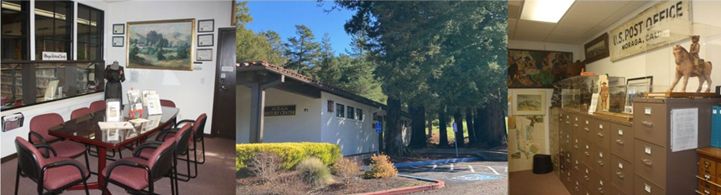
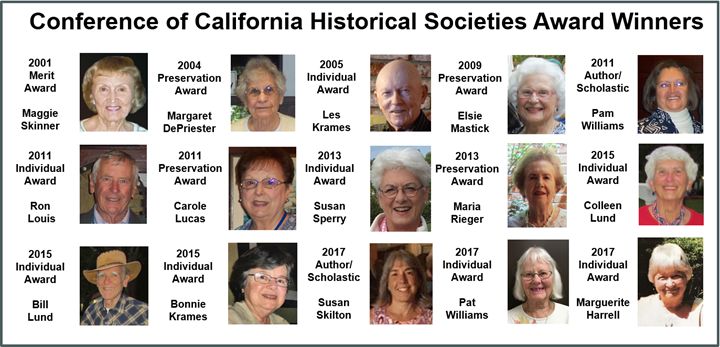
Notable MHS archivists since our History Center Opened
Moraga’s Pride as our first effort to make Moraga History accessible to everybody
It was in 1985 that the Moraga Historical Society Board decided that the rich history of Moraga needed to be documented to “fulfill the mission to gather and preserve knowledge about the history of the land grant Rancho Laguna de los Palos Colorados. . . “
Brother Dennis Goodman, FSC, was the librarian of St. Mary’s College and had already accumulated a plethora of research concerning the area. “St. Mary’s grounds had a graveyard of 24 Indian skeletons. An interesting find was mortars made of stone not of this area, which indicated trading among Indian tribes,” explained Brother Dennis. “I have all kinds of information, and I don’t know how to finish it off.”
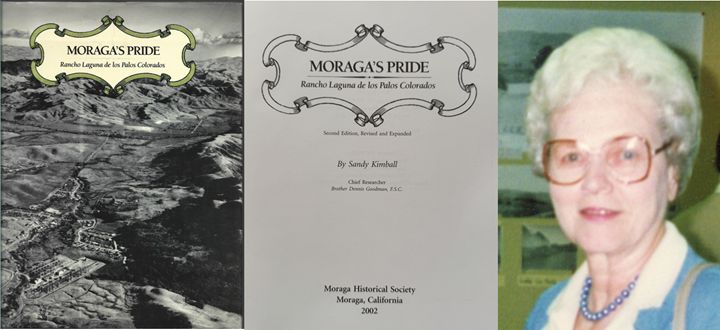
Enter veteran writer/journalist Sandy Kimball of Lafayette who was hired to compile the abundant research Brother Dennis had recorded into Moraga’s first history book. Kimball had already authored history books on Lafayette and Orinda and was an ideal choice to document Moraga’s rich history. A UC Berkeley graduate with a degree in journalism, Kimball had worked on local newspapers and radio stations, and she was a private freelance writer when contacted. Her task was to trace two centuries of Moraga history from prehistoric times to incorporation. In writing Moraga’s Pride Kimball skillfully interwove the various cultural, sociological, and technological developments that contributed to the vibrant Moraga Valley of today. Two Moraga residents – Les Krames provided the drawings, and Maggie Skinner selected the photographs. In June 1987, after just one year and eight months, the book was complete, and sales began on October 15, 1987! The first edition print-run sold out and in 2002 MHS published the second edition.
In honor of our 60th anniversary, MHS is offering a free Moraga’s Pride book with each new membership. If you are already a member and own the book, please encourage others to take advantage of this offer!
Romerias, Potlucks, Banquets and Speaker Events
When the Moraga Historical Society began in 1965-66, the community of Moraga consisted of young families new to the area! The MHS monthly meeting featured guest speakers highlighting points of interest in Moraga, early founders, native Americans, stories from the “old timers,” the history of SMC, American presidents, World War II stories and much more. These meeting were held in members’ homes, local schools, on the St. Mary’s campus, and in the Community Room of the Moraga Library. The speaker series took a hiatus during Covid but resumed in 2022, taking place in the Hacienda Casita on Sunday afternoons featuring programs about Native American locations in the Bay Area, fictional mystery novels taking place in local sites, the history of the trains in Moraga, and Moraga’s first mayors.
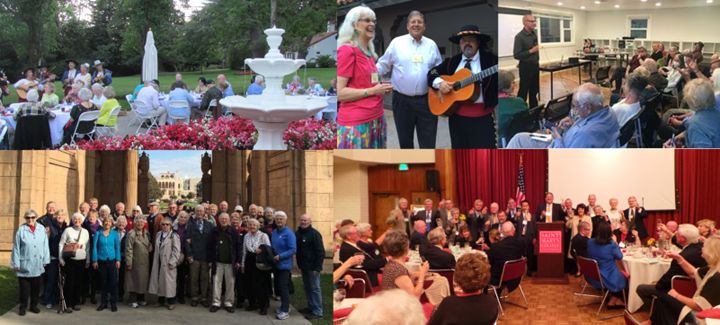
“Romerias,” were organized field trips to missions, museums, parks, and historical sites beyond Moraga. In the early decades of Society, children were included, and families drove their own cars to their destination. In later years, the Romerias became bus trips to destinations such as “A Tour of San Francisco’s Historical Sacred Spaces,” the Barbary Coast District, the Panama-Pacific International Exposition of 1915 sites, Mont La Salle and Hess Collection in Napa, the Jacuzzi Winery, to name a few. These trips were guided by a docent and included lunch, and a day’s worth of fun and companionship.
Potluck dinners were held in August at the Hacienda de los Flores, and an anniversary banquet was held every October to celebrate the founding of the Moraga Historical Society. The latter was a formal event held at St. Mary’s Soda Center with a sit-down dinner and presentation. In 2014, MHS organized the banquet for the 40th anniversary of the incorporation of the Town of Moraga. Due to Covid, increasing rental fees and rising catering costs, potlucks and banquets have not taken place since 2019.
MHS Newsletters
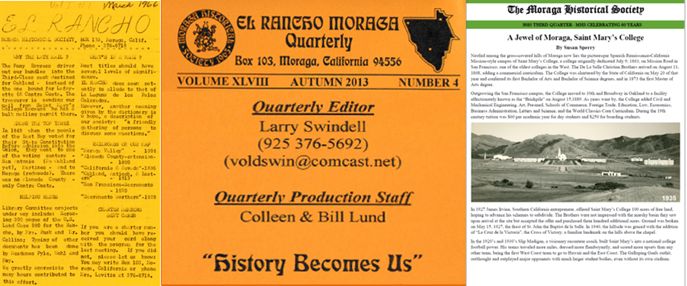
The “El Rancho” monthly newsletter was an excellent source keeping the Moraga Historical Society membership informed of speaker reviews, future MHS events, highlighting Board business decisions and reviewing community development. In later years the newsletter included a section devoted to Moraga history. As Les Krames, (augmenting each edition with his artwork), Larry Swindell (2012-2015) and Bill Lund (2015-2020) assumed the role of producing the newsletters, each editor reached beyond the Lamorinda area to broader California history and produced a black and white printed 40-page booklet. Since 2020 the newsletter remains quarterly but is an 8-10 page color production specific to Moraga/Lamorinda, reviewing speakers, featuring historic themes, and is created in coordination with Susan Sperry, John Kaiser, and Vera Kochan. Hardcopy is mailed to MHS members and copies are made available online as a pdf. History articles are extracted and posted as individual excerpt web pages, which allows adding photos unable to fit into hardcopy. Check out moragahistory.org for past scanned editions.
The new MHS Challenge: moving our physical archives online
The creation of the History Center was a huge milestone for the Moraga Historical Society. But today it faces a new threat. Climate change has increased the fire risk. Insurance companies are canceling home insurance left and right. The fire department is working on risk mitigation. But you cannot assume it will never happen here. The thought that 60 years of painstaking collection and archiving of paper documents might go up in smoke terrifies us. Many documents are irreplaceable. Searching the Internet for local history turns up mainly material we have already put online. The flow of donated archival documents is not what it was during the early decades. MHS has done a great job preserving the past. The new challenge is to preserve these paper archives by migrating them online. Our goal for the next decade is to digitize our physical archive collections. As we get our scanning process optimized we will be hoping that volunteers step forward to help us with this monumental task! Contact us if you are interested in being part of this project.
