The Fight for Open Space in Moraga
By Susan Sperry Excerpt from Newsletter 2025 Q1
James Irvine, once the sole owner of much of the Rancho Laguna de Los Palos Colorados (future Moraga), died in 1947 and control of the rancho was transferred to the Utah Construction Company. From 1950 until 1957, Moraga was just a rural stop on the railway line from Oakland to Sacramento. The first of four “Moraga Area” General Plans was written prior to incorporation by the Contra Costa County Planning Department in 1955. Moraga was still relatively isolated and undeveloped. By 1963, Moraga had four major access roads (St. Mary’s, Canyon, Moraga Roads, and Moraga Way) and the Rheem Shopping Center, built by Donald Rheem.
As early as 1965, Contra Costa Supervisor James Moriarity suggested the county adopt a “green belt” ordinance to preserve open spaces which the Board of Supervisors approved November 1965. The Ford Foundation in 1969 financed a study “People for Open Space”. In early 1970 the Association of Bay Area Governments (ABAG) developed an Open Space plan to preserve open space in the Bay Area, feeling it essential to preserve the open feeling of the bay area and protect natural resources. The state legislature in 1971 passed legislation requiring each county in California to develop an open space element in its general plan.
In 1970 Harold Smith, builder of much of Moraga, showed concern for the lack of interest in the community in taking action to ensure that the ridges be left unscathed by bulldozers and left for large estate type parcels with hiking and riding trails. Smith stressed that Moraga is at a crossroads. Residents must take some interest in what is happening to their open space. If the remaining sharp, steep areas are not developed into larger parcels with recreational area, trails, and open space, contractors will develop Moraga with typical tract type homes.
Residents did act, and, in 1974, the city of the Town of Moraga was incorporated, the 15th city in the county and the only one to achieve cityhood in the state that year! The new city of the “Town of Moraga” included only 9.53 square miles of the old Moraga planning area. Local control over future land development, “home rule” and an enhanced community identity were major reasons for the successful effort. The need for comprehensive, long-range planning for managed growth subsequently led to the General Plan formation program with maximum citizen participation through data-gathering committees, Town Hall meetings and public hearings. A five-year moratorium was placed on development until 1979, when the General Plan was adopted.
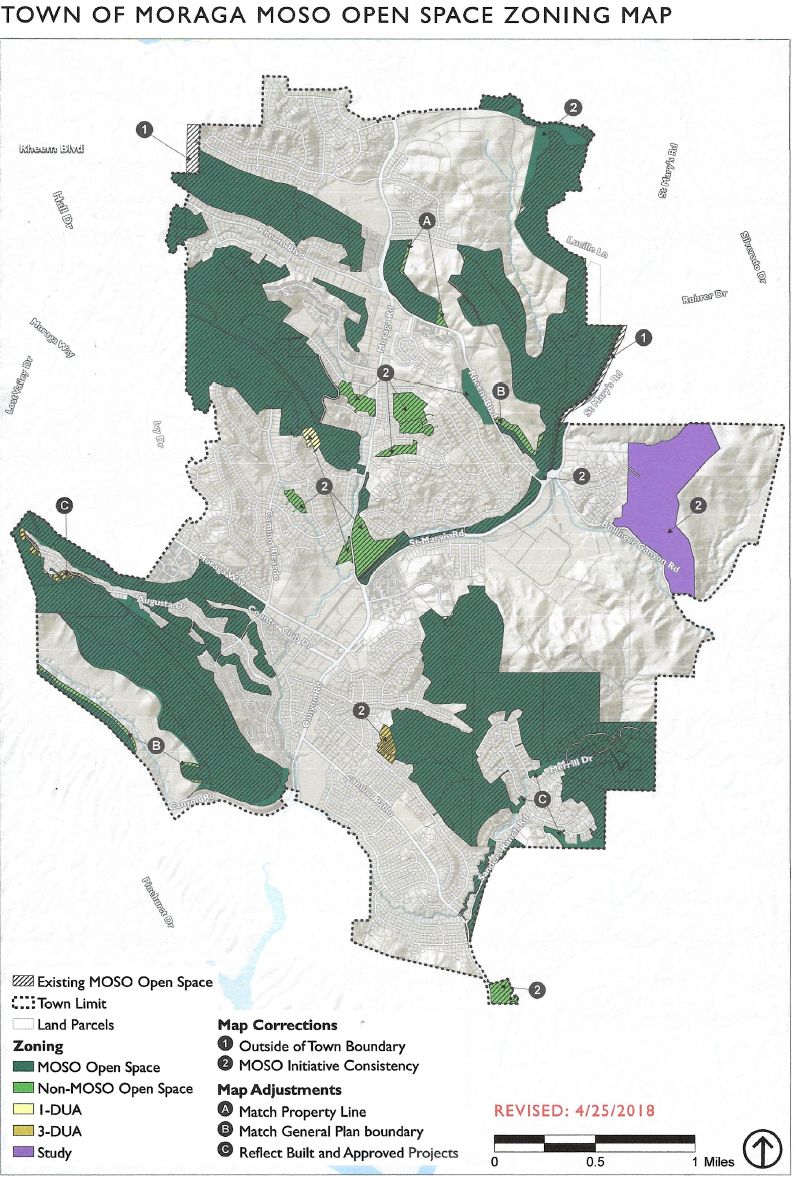
Many Moragans pleaded for years with Town government to take action to control development and felt outside developers were pressuring the Council to let them build poorly conceived tracts on fragile, unstable, slide-prone lands. With the threat of a large subdivision in the Rheem Valley area and loopholes in the existing General Plan, the Rheem Valley Homeowners Association requested that the Town Council authorize the Planning Commission to undertake a study of the General Plan, specifically as it pertained to ridge and hillside open space, asserting that density in those areas needed to be revised downward and that density transfer and cluster development appear to be inappropriate for those open space areas. The Town Council directed the Planning Commission to do so on October 16, 1985. On November 8, 1985, a response was received from the Open Space Committee of the Planning Commission reporting their observations. The Town Council then authorized a building moratorium excluding the large subdivision causing the concern of the Rheem Valley Homeowners Association. In response, the concerned residents, in arms about a potential subdivision formed “Moragans to Save Open Space” and authored and sponsored MOSO (Moraga Open Space Ordinance) to be placed on the April 8 ballot. MOSO served to do three significant things for future development in Moraga: 1) Prohibit development on minor ridgelines, defined as ridges 800 ft. in elevation; 2) Prohibit development on hazardous areas that are geo-technically unstable, and 3) Prohibit building on slopes of 20% or greater. On April 8, 1986 the ordinance passed with 51% of Moraga voters approving.
Lawsuits filed by two developers against the Town claiming MOSO unconstitutional, inconsistent with the Town’s General Plan and a violation of the state housing statutes were rejected by the Contra Costa County Superior Court in December 1987. This decision has become a landmark decision in California case law.
In 1998, after two years of lively debate, the Town council clarified and eliminated inconsistencies between MOSO and the Town’s General Plan and zoning ordinances, particularly concerning the development of recreational facilities on open space lands.
In reaction to seven large subdivisions being proposed before the Planning Commission in 2008, concern again fomented regarding the strength of MOSO. As a result, two initiatives were placed on the November 2008 ballot to protect Moraga’s open space. The electorate voted on two different views of open space land use which could have a lasting impact of future development in Moraga. Eight months of discussion and debate over the merits of each initiative ended in neither initiative receiving enough votes to change MOSO.
On April 11, 2018, the Moraga Town Council unanimously voted to update and strengthen its open space development regulations, which began in 2013 when first proposed. For five years, the Town gathered community input through a series of public meetings, workshops, study sessions, and focus groups. This input overwhelmingly favored stronger protection of open space, ridgelines, scenic views and hillsides. The Town Council adopted a set of revisions to the General Plan, Municipal Code, MOSO Guidelines, and Design Guidelines that clarify and strengthen the rules governing development on steep slopes, grading of “high risk” areas, viewshed protection and ridgeline protection.
The history regarding preservation of open space reflects the ongoing concern among residents of Moraga to protect the semi-rural nature of our town on the one hand and the reasonable entitlement of landowners to develop their property on the other hand. With each new development proposal challenge, the MOSO Pandora’s Box opens anew. In most recent discussions on this issue, thoughtful debate and compromise has led to reasonable conclusions. Visit the Town of Moraga’s Planning Documents page to retrieve a MOSO pdf.